• Required reading for all forum users!!!

    Welcome!
    Register to access the full functionality of the GSResources forum. Until you register and activate your account you will not have full forum access, nor will you be able to post or reply to messages.

    A note to new registrants...
    All new forum registrations must be activated via email before you have full access to the forum.

    A Special Note about Email accounts!
    DO NOT SIGN UP USING hotmail, outlook, gmx, sbcglobal, att, bellsouth or email.com. They delete our forum signup emails.

    A note to old forum members...
    I receive numerous requests from people who can no longer log in because their accounts were deleted. As mentioned in the forum FAQ, user accounts are deleted if you haven't logged in for the past 6 months. If you can't log in, then create a new forum account. If you don't get an error message, then check your email account for an activation message. If you get a message stating that the email address is already in use, then your account still exists so follow the instructions in the forum FAQ for resetting your password.

    Have you forgotten your password or have a new email address? Then read the forum FAQ for details on how to reset it.

    Any email requests for "can't log in anymore" problems or "lost my password" problems will be deleted. Read the forum FAQ and follow the instructions there - that's what we have one for...

  • Returning Visitors

    If you are a returning visitor who never received your confirmation email, then odds are your email provider is blockinig emails from our server. The only thing that can be done to get around this is you will have to try creating another forum account using an email address from another domain.

    If you are a returning visitor to the forum and can't log in using your old forum name and password but used to be able to then chances are your account is deleted. Purges of the databases are done regularly. You will have to create a new forum account and you should be all set.

Welding is super easy...

Sam 78 GS750

Forum Mentor
Past Site Supporter
and really freaking hard! It's a lot of fun... and incredibly frustrating.

I finally bit the bullet and bought a welder. This one --->https://www.harborfreight.com/flux-125-welder-63583.html

After needing a crack in my frame welded and some brackets welded on to the frame, and paying and waiting for someone else to do it... I decided that if I needed anything else welded during the course of my rebuild, I was gonna buy a welder and learn to do it myself.

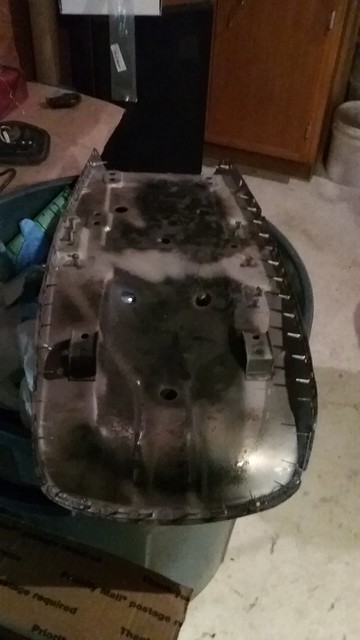
Got to the seat pan, and most of the hooks for the cover were rusted and trash. Got some upholstery tack strips and the welder and set to reading up then practicing.

After a few welds where I was able to just pull them right apart, I got a couple of strong (if ugly) welds on some stainless steel brackets I had lying around.
20180626_211621 by samL9, on Flickr

20180626_213327 by samL9, on Flickr

I damn near broke my hand trying to break the welds, so not bad for a first trial run... :triumphant:

Moved on to practicing with some thinner metal...more like the seat pan and strips. Either they don't hold or I burn right through. :confused:

After some more googling, reading and watching youtube vids, I realized that Max or Min being the only heat/current settings on the cheapo Harbor Freight unit I got is the issue...

I'm getting close to finding the sweet spot between not holding it long enough to get penetration, and holding it too long and burning right through the metal (while working with the limitations of the settings available on the welder I got).

Not quite brave enough to try it on my actual seat pan just yet though...
 
Isn't that the truth....
I have an old Miller machine. It comes in handy at times. Last uses were welding my broken fairing bracket, and welding a broken fairing mount lug back onto the frame. Definitely a bit of a leap of faith welding on the frame.
 
I can weld... but am certainly not a welder. What I lack in skills I make up for in slag and lots welding rods. If its something that requires "real strength" or beauty I take it to a shop.
 
I bought one of the HF welders about 10 years ago and the only regret was not getting a better welder. The HF is quite functional. Get some quality wire and there are some mods to reduce the length of the wire cable so you reduce the resistance pushing the wire through. The biggest factor in a smooth weld is constant feed velocity. I have found the stainless wire too brittle, so kind of stay away from that unless you are welding stainless. HF has upgraded thier line and the quaklity seems to have really improved. A US name brand (e.g. Miller) is going to cost twice what HF goes for.

Get a flap wheel and it really helps clean up the slag.(mounts to an angle grinder)
https://www.globalindustrial.com/p/...9wJPqr-rr3Brb-9aUodjG6xSwO-uhiHxoCzVQQAvD_BwE
 
Last edited:
I think getting a higher quality welder definitely would have helped, but for the amount of welding I would do I couldn't justify the cost. An angle grinder and flap wheel is definitely on the shopping list for the near future, Posplayer. For the trial runs/practice, I was just using my Dremel to clean things up...

After a lot more trial and error, and some more googling I discovered "plug welds". That seemed to do the trick, but I was still burning through the upholstery strips about 25% of the time on practice pieces. They're only like .7mm thick... Not to mention that I would have to plan out all of my welds and drill dozens of holes in precise locations on all of the strips...

I did some more googling, and watched a few more vids, and decided that a spot welder would be the right tool for the job. The harbor freight flux core welder with it's limited settings, and my rookie abilities on the thin metal of my seat pan (thinner in spots after removing rust, etc.) just didn't give me a warm and fuzzy feeling.

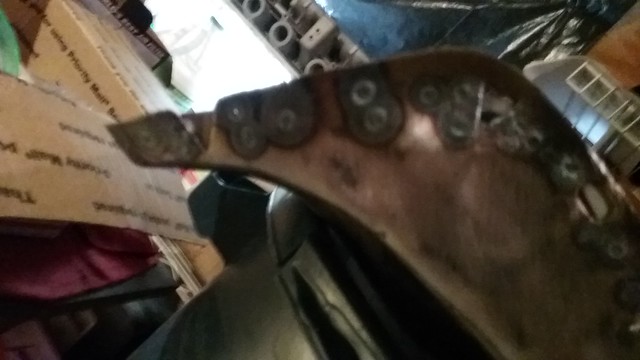
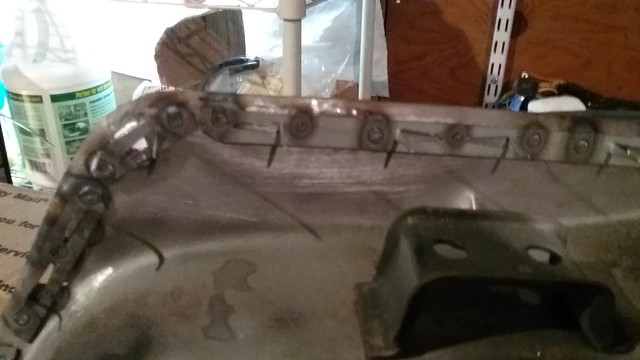
I picked one up, and after a couple of practice runs to get a feel for how long to hold contact, the spot welder made short work of getting the tack strips on my seat pan. The welds are strong (strong enough to hold some vinyl in place at least). On my practice pieces, I tore the strips before the welds broke...

I did use the flux core welder to repair a few cracks in the pan. I drilled a hole at the end of the cracks, filed a valley along the cracks and then ran a bead along them. Came out decent for something that will be hidden under foam... :-\\\
 
You're a brave man welding on the frame, Dorkburger.... Like TxGSrider, I think I'd probably take anything like that to a shop for now...
 
For a little more money you could have got a decent stick/tig machine which would allow you to produce much better welds.
 
if I may, your local community college PROBABLY has some welding courses available, they are a bargain in terms of knowledge and expertise you are able to gain, plus they have top-notch equipment to work with. Frequently, the instructors are very amenable to "government projects" in the shop. Well worth the time and money, if you really want to weld and not just stick 2 bits of metal together.
 
+1 on the community college. At SBCC they used to have a nice program for nite classes (in the mid 1980's), that has long gone. I ended up welding several things that were structural with my $100/110V HF flux wire welder.
I would have to do a lot of grinding to clean up the welds, but I coudl get the job done without having to drop it off at a welder and go and pick it up. In SB at least I had a very good welder for all my aluminum work, but having the ability to do quick jobs was very fulfilling.

The rear brake knuckle below is pretty thick at least a 3/16" tank that needs to be cut off and moved over to fit the Bandit swingarm. Did not turn out bad at all. These little HF units will get a whole lot more penetration than a spot welder. You have to keep the feed going and close to the work to maintain the pool.


Here is the modified rear brake pivot knuckle. I cut off the little arms and rewelded them about 5 mm each to provide clearance for both the rear brake plunger rod and the return springs between the frame and the bandit swinger. A 4.5 mm offset to the Bandit arm is required to accomplish this. No other spacers behind the master are required. Basically this allows me to keep the stock pegs, rear brake pedal and master cylinder and no welding on the frame. Here is the finished modified part:
View attachment 36190


I also had a situation when I was just about to complete my GS1100ESD resto-mod during final assembly. I was bolting up my SU-145 ($1500) Ohlins and the left side mounting stud twisted right off. I was ****ed. By bike was virtually completely done but not ridable. I could have taken the entire bike bow to the welder, but that would have been a pita. But I was especially ****ed at whoever had done such crappy work on something so important. The threaded portion of the shock mount had been twisted off in the past and they spot welded back on and called it good enough. I got a welding blanket to protect the bike and welded on another threaded portion and cleaned up the slag.

So if you don't fell comfortable, then get someone else to weld it, that said there is no reason why it can be welded with one of these little welders. You could also even brace a frame, the only problem is all of the slag you would have to clean up.

The other thing is you can also tack weld something in place for fit then remove the part and get someone to go over your welds and make then strong (e.g. exhaust hangers).
 
Last edited:
You're a brave man welding on the frame, Dorkburger.... Like TxGSrider, I think I'd probably take anything like that to a shop for now...

I was a bit apprehensive, but made sure the area was completely clean, had a good ground and concentrated the heat on the lug since it had more mass then the frame.

Not pretty, but after a shot of paint its fine. Out of sight anyway.
http://Untitled by Glen Brenner, on Flickr
 
Last edited:
Not a bad idea on the community college. My township also has a bunch of 'adult education' courses, so I can check to see if they have a welding class. I think they offered some community classes at the vo-tech back in the day, so I can look into that too.

It's definitely a lot of fun so far, and a good skill to have. I don't think I'll ever call myself a welder... More likely, a 'guy who can weld'.

The flux core welder did a decent job on the cracks on the seat pan.
For welding the super thin tack strips, it would just burn right through way before I could get any penetration into the seat... I wouldn't trust the spot welder for anything structural or anything that would need to withstand any amount of force...but for holding a vinyl seat cover on, I think it was perfect.
 
160 Amp Stick-TIG machine. Scratch start TIG. 155~230 volt capability. $199 shipped. You would need a bottle of Argon and a regulator to go with it in order to use TIG. That can be added on later.

https://www.ebay.com/itm/ST-165-165...386858?hash=item238db6406a:g:LiYAAOSwoaFZuChF


You CAN weld sheet metal with a stick electrode.


You CAN weld 1/2 steel with a 160 Amp machine. Usually 125 amps on a 1/8" electrode. Might need to crank the amperage up to 140 when welding that thick of metal.
 
Last edited:
Dale, I know that you're very thorough, but if you haven't, you may want to check that blower wheel for wobble / imbalance.

Nice repair work.
 
She's been working just fine for the past two years or so. No rusted or bent vanes on that one. Bearings went out on the motor. I even was the one who originally installed the furnace. :)
 
Back
Top