• Required reading for all forum users!!!

    Welcome!
    Register to access the full functionality of the GSResources forum. Until you register and activate your account you will not have full forum access, nor will you be able to post or reply to messages.

    A note to new registrants...
    All new forum registrations must be activated via email before you have full access to the forum.

    A Special Note about Email accounts!
    DO NOT SIGN UP USING hotmail, outlook, gmx, sbcglobal, att, bellsouth or email.com. They delete our forum signup emails.

    A note to old forum members...
    I receive numerous requests from people who can no longer log in because their accounts were deleted. As mentioned in the forum FAQ, user accounts are deleted if you haven't logged in for the past 6 months. If you can't log in, then create a new forum account. If you don't get an error message, then check your email account for an activation message. If you get a message stating that the email address is already in use, then your account still exists so follow the instructions in the forum FAQ for resetting your password.

    Have you forgotten your password or have a new email address? Then read the forum FAQ for details on how to reset it.

    Any email requests for "can't log in anymore" problems or "lost my password" problems will be deleted. Read the forum FAQ and follow the instructions there - that's what we have one for...

  • Returning Visitors

    If you are a returning visitor who never received your confirmation email, then odds are your email provider is blockinig emails from our server. The only thing that can be done to get around this is you will have to try creating another forum account using an email address from another domain.

    If you are a returning visitor to the forum and can't log in using your old forum name and password but used to be able to then chances are your account is deleted. Purges of the databases are done regularly. You will have to create a new forum account and you should be all set.

Well...

I noticed that these fuses can only be tested with the key on. Noticed that the power loss on the fuse input went down a volt when i took the fuse out, I'll be getting a new one to see if theres a

You can only measure a voltage drop when the circuit is LOADED and current is flowing.

(That is the problem with using an ohm meter to find poor connections in a circuit. The ohm meter loads the circuit with milliamperes of current. Any old lousy connection can pass milliamperes of current just fine. But load the circuit with live current and those coils may draw 5 amps of current. Poor connections and switch contacts can’t pass that mush current and they begin to generate heat, which adds more resistance. It’s voltage drops that generate the heat.)

You can measure the voltage drop across that ground that grcamma2 has identified. Just load up the circuit that uses that ground and measure the drop from the ground wire eyelet and the negative battery post. That will tell you how much voltage is being dropped through that particular ground path.

Just remember a circuit will drop ALL the voltage available. In your coil circuit, the more voltage that is dropped on the coil’s power circuit, and the more voltage that is dropped on the coil’s ground circuit, the less voltage the coil has to play with.
 
Oh, and on those glass fuses, pull them out and polish the metal ends. Then polish the clips that hold the metal fuse ends.
And flip the fuse block over and see if there are any questionable solders on the back side of the fuse block.
 
I bought new fuses, unfortunately the battery wont take a charge at oriellys, gotta wait till tomorrow to do anymore testing. Will be cleaning stuff up.
 
I dont know if this means anything but I noticed when I tried to put a 15amp fuse in the ignition fuse, my. Lights turned on. Just took it off the fuse wasnt even in, I was trying to see if a new fuse would help with the voltage loss.
 
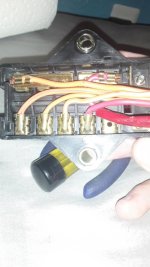
It does look pretty clean in the fusebox, I'll be cleaning some connecting spots but theres not much to be done, I cleaned all areas that fuses go into and also noticed my power source fuse was a 20amp.... well it's supposed to be a 10, so I hope when I have a 10 amp in there it doesnt blow.


Snapchat-970154055.jpg
 
Update on voltages, pretty happy with it except the fuses that are connected to the killswitch.

Battery post is always gonna be positive and the red meter lead for all these tests


Battery post to fusebox .14v

Battery post to power source fuse .14v

Battery post to main fuse .16v

Heres where my noobiness comes in, I had the killswitch on when I had almost 3 volts but did shave off about .4 of a volt.

Battery post to ignition fuse 1.35v

Battery post to turn signal fuse 1.57v

Battery post to head fuse 1.42v

Battery post to ignition wire connection ( second end of the plug with all these fuse wires) 1.41v

Total loss to the coils from battery post. 3.78v

So I guess I should checkout the killswitch, to verify, that's the ignition switch right?
 
Snapchat-1557711244.jpg

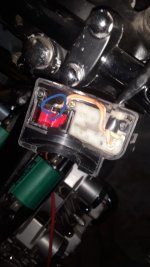
Losing a whole volt here at the switch itself, where to clean? I'll clean this metal contact off here but not sure if that's what I should be.

Gonna check the plugs I've never touched they are very grimy on the outside, hoping the same on the inside so it will bring back lots of voltage.
 
Now what really sucks is the plastic cube holding all those tiny connectors split in half when getting pulled apart.

Well, I took pictures and videos of the connections on the cube to make not of which ones go to which, so tomorrow they will be cleaned and if finished and nothing else goes wrong, possibly connected and we will see howmuch voltage I get back
 
So I guess I should checkout the killswitch, to verify, that's the ignition switch right?

No.
I don’t have GS650, but on my GS, the ignition switch is where you put the ignition key.
The kill switch is a button on my right hand grip that will shut off the coils when pressed.

Also, shouldn’t your ignition fuse be 10 amps and your main fuse be 15 amps?

Better double check with your wiring diagram.
 
Update on voltages, pretty happy with it except the fuses that are connected to the killswitch.

Battery post is always gonna be positive and the red meter lead for all these tests


Battery post to fusebox .14v

Battery post to power source fuse .14v

Battery post to main fuse .16v

Well, testing with the red meter lead always on the battery post means each subsequent reading will be the cumulative voltage drop on that circuit.

When I’m trying to find where in a circuit the voltage drops are occurring I like to measure each segment of the circuit.
For example, with KOEO, the red meter lead on the positive battery POST (not the positive battery cable clamp) and the black lead on the power side of the main fuse holder, the meter will read just the voltage drop in that segment of the circuit.
So you would be checking the connection of the battery post to the battery cable clamp, the battery cable clamp to the battery cable, the battery cable it self, the connector at the other end of the battery cable, it’s connection to the starter solenoid post, and so on and on and on until where the black meter lead is on the power side of the main fuse holder.

Then, what I WOULD do, is put the red meter lead where the black meter lead was (on the power side of the main fuse holder), and move the black meter lead to the ground side of the main fuse holder. Now the meter will read the voltage drop where the main fuse holder contacts the main fuse, the drop across the main fuse it self, and where the main fuse contacts the ground side main fuse holder.

Then get out your wiring diagram for your machine and continue testing each segment of the coil circuit and find out how much voltage is being dropped and just where.

Have some patience and stay focused on just the coil circuit. Your wiring diagram will indicate which connectors the circuit passes through, some will be up under the fuel tank, in the headlight bucket, through switches, etc. (Remember, I don’t have a GS650.)
 
No.
I don’t have GS650, but on my GS, the ignition switch is where you put the ignition key.
The kill switch is a button on my right hand grip that will shut off the coils when pressed.

Also, shouldn’t your ignition fuse be 10 amps and your main fuse be 15 amps?

Better double check with your wiring diagram.


Oh okay got it, i was wrong.

My main is 15 and ignition is 10 yes, but the power source fuse had a 20 in it and its a 10
 
We did get the total loss down to 3.5v after cleaning of one of those connection boxes, the other one will be next.


What I did notice is there is a white wire that does not plug into anything, and I didnt lose my marbles while doing this, i even took some pictures and videos lastnight for today and i made sure to count the wires I listed on each side of the plug, 7 on one side, and 8 connections on the other.

I will be starting the other plastic box tonight or tomorrow, and after that, the main ignition bit will be done if i dont get most of the voltage back by that.

I also did get some of the fuse losses down and it's basically the same amount I gained back to my coils, about .3ish volts.

Glad I'm slowly getting it back but I'm waiting for that one big gain back to happen!


I want to ask to see where I should be shooting but what is an exceptional amount of total loss at the coils? I'll be doing as much as I can but still, I'd like to know. I would really want to get the total loss at 1 volt or under but if 2 volts or a bit less is okay, and I've done all I could by cleaning them, i wouldn't mind that.
 
Do you, or do you not, have a wiring diagram for your GS650?

I can’t work on my bike’s electrics without a wiring diagram.

If your 650 is similar to my 750, I’d estimate that electrons leaving the positive battery post travel 12 to 15 feet of wiring and cables, 2 switches, close to 12 connectors, 2 fuses, and who knows how many solder joints just to GET to the power side of the coils circuit.

Then you can measure the voltage drop the same way on the ground side of the coil circuit. From the ground side of the coil all the way to the battery’s negative post.

Say maybe you are dropping 3 volts on the power side of the coil circuit, and you are dropping 2 volts on the ground side of the coil circuit. That means with a nominal battery voltage of 12 volts, your coil only has (12v-5v=) 7 volts to work with.

IIRC, I found a good portion of the voltage drop on my machine was in the ignition switch and the kill switch. And believe it or not, some of my fuses were dropping more voltage than I would have suspected.

And if you trace out your wiring diagram you might find nearly ALL the voltage your bike uses (think headlight, turn signals, etc,) has to go through that little ignition switch. If the switches contacts are corroded or cruddy(copyright), that will create more heat and more voltage drop.

If you are brave enough to try and open that switch to clean its contacts, be sur and search this forum to learn how to do it without having parts and spring fly to places where you can’t find them.

Good luck with your project.
 
I do have a diagram I'm starting to use it.

The ignition switch at the plug is very clean, still made sure to clean connections and give a good blow on both ends, stuck it back on and it wont be touched. But the switch itself will very possibly have to be cleaned, haven't took a look yet been cleaning other plug connections.

So I checked my total loss at the coils both positive and negative. I'm at 3.4v missing for the positive side and 1.5v missing on the negative side, and I get 7.5v at my coils right now.

I just finished cleaning some super SUPER dirty connections and after a quick wipe again they will be plugged in, now I'm not expecting alot to be gained back but I think I'll get a decent chunk.

Only a few things left able to be cleaned after this.
 
3.3v total loss positive side and 1.3v total loss negative side, have 7.55v at coils.

Ignition switch will definitely need to be done, and the killswitch aswell.
 
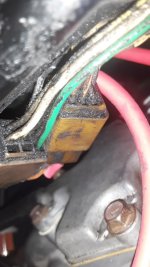
Okay so, messing with the killswitch bit, cleaned off the metal I could, also cleaned spring and stuff behind the starter button. No change in voltage loss so it must be internal on the killswitch assembly, I've cleaned the connections on the plugs right next to my right side coil, the picture of those super grimy plugs I posted, and I did get some voltage back so those should be fine.

However, if its not internally in the killswitch assembly either a wire will need to be replaced or my harness would need to be opened up.

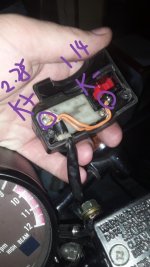
Heres what I noticed at the killswitch, key on engine off, k+ means killswitch on and k- means it's off. I know that turning the killswitch on consumes I believe a volt of energy so the real difference is about .6v which still is a good amount. Snapchat-1836785192.jpg


Edit: just realised I can test voltage loss at the connection where the plug was to see if its before or after that part. Ugh, it's been sealed up but can be undone
 
Last edited:
Edit: just realised I can test voltage loss at the connection where the plug was to see if its before or after that part. Ugh, it's been sealed up but can be undone

Sounds like your getting the hang of it. You can back probe what ever connector you can access just before the ignition switch with a pin, and back probe whatever connector you can get to just after the ignition switch, put your meter probes on the pins, and with KOEO, your meter will read the voltage drop across the ignition switch to see if, or how bad it is. Ditto with the kill switch. Heck, ditto with any connector!

Just remember, in order to be able to read the voltage drop, the circuit MUST have current flowing through it to get a valid reading.
 
Well, cleaning the ignition switch didnt change anything, I'm gonna have to check the killswitch wire seeing where that volt I'm losing is coming from.

So the only things left I can mess with that i can think of is, turn signal switch, maybe some relays or flashers, and my horn.


There is one wire unplugged on my.horn and I hope its what's causing this loss, I guess I'll do the KOEO real quick and see if anything is drawing to it, ifso I will need to learn how to wire the horn. If I plug the wire in the one open connection I have, when i turn the key on the horn will constantly go off, so I see why the PO left it unplugged.
 
Back
Top