• Required reading for all forum users!!!

    Welcome!
    Register to access the full functionality of the GSResources forum. Until you register and activate your account you will not have full forum access, nor will you be able to post or reply to messages.

    A note to new registrants...
    All new forum registrations must be activated via email before you have full access to the forum.

    A Special Note about Email accounts!
    DO NOT SIGN UP USING hotmail, outlook, gmx, sbcglobal, att, bellsouth or email.com. They delete our forum signup emails.

    A note to old forum members...
    I receive numerous requests from people who can no longer log in because their accounts were deleted. As mentioned in the forum FAQ, user accounts are deleted if you haven't logged in for the past 6 months. If you can't log in, then create a new forum account. If you don't get an error message, then check your email account for an activation message. If you get a message stating that the email address is already in use, then your account still exists so follow the instructions in the forum FAQ for resetting your password.

    Have you forgotten your password or have a new email address? Then read the forum FAQ for details on how to reset it.

    Any email requests for "can't log in anymore" problems or "lost my password" problems will be deleted. Read the forum FAQ and follow the instructions there - that's what we have one for...

  • Returning Visitors

    If you are a returning visitor who never received your confirmation email, then odds are your email provider is blockinig emails from our server. The only thing that can be done to get around this is you will have to try creating another forum account using an email address from another domain.

    If you are a returning visitor to the forum and can't log in using your old forum name and password but used to be able to then chances are your account is deleted. Purges of the databases are done regularly. You will have to create a new forum account and you should be all set.

Why does Suzuki split R/R + output between ignition and battery?

I think you have your self a little confused.

Easily done this time of night for me.

...where the current flowing between the battery and R/R is only charging current.

So that is at the factory "T" point? Add the in-line fuse there?

Thanks for your (continued) help and support to the mere mortals of electrical/technical knowledge here like myself!
 
Wait - I want another stab at it.


The question is
A.) where do you put the fuse to protect the bike from the battery shorts and
B.) where do you tap off from the battery R/R to power the rest of the bike.

I love it, you're like the Zen Master at the top of a mountain where a mortal, non-technical noob like me scales the top to ask a question that to them is difficult and when posed to the Master, he returns with deeper, even more technical questions as his answers! :D Helping us understand the deeper meaning behind all of this!

So I'll take a stab at it;

A.) where do you put the fuse to protect the bike from the battery shorts? At the battery?
B.) where do you tap off from the battery R/R to power the rest of the bike. At the "T"? The part "battery R/R" has me confused...

Help men Zen Master Pos, enlighten me or kick me off the mountain?
 
Wait - I want another stab at it.


I love it, you're like the Zen Master at the top of a mountain where a mortal, non-technical noob like me scales the top to ask a question that to them is difficult and when posed to the Master, he returns with deeper, even more technical questions as his answers! :D Helping us understand the deeper meaning behind all of this!

So I'll take a stab at it;

A.) where do you put the fuse to protect the bike from the battery shorts? At the battery?
B.) where do you tap off from the battery R/R to power the rest of the bike. At the "T"? The part "battery R/R" has me confused...

Help men Zen Master Pos, enlighten me or kick me off the mountain?


The answer to the Questions:
A.) At the battery yes, but more specifically between the battery and the "T" , because the "T" is really the point that brings the two sources together ( battery and R/R output). If you short anything connected to the "T" a lot of current will try and flow from the battery, through the "T" to wherever the short is. That fuse limits that current to a safe level so the the wiring in the harness will not melt.

The R/R output doesn't need to be fused here as it is fused down stream in each of IGNITION, HEADLAMP,SIGNAL. The real reason for the main battery fuse is in case the R/R shorts, it is directly across the battery and you will have a fire.

B.) Yes you Tap off of the "T" for all currents. In contrast If you tap off of the battery +, then all of the R/R current has to run from the R/R(+) to the battery (+) and then go on to it's final load. That means the full R/R current (15 amps) has to all run between the R/R(+) and the Battery(+) to get to the load. That creates the biggest voltage drop possible for a given about of connector resistance.

If you pull current from the "T", then the current from "T" to battery (which includes fuse box and big bullet connector) only carries 3-4 amps maximum with a corresponding drop in the voltage drops meaning the battery voltage will be closer to the R/R output voltage.

The construction of the "T" on the positive side, is basically the same as a Single Point Ground on the ground side. It minimizes the sharing of currents, by splitting the currents as close to the source or return as possible. This avoids sharing of currents.

In the case of the "T" it is no sharing of load current with charging current between battery and R/R. You will have to study the examples and ask specific questions about them, because my answers are going to get more theoretical which probably doesnt help.

There is nothing really mysterious, you just have to understand the splitting of currents and the desire to reduce the current between battery and R/R so that the voltage drops are less.

This is what the revised Phase A is trying to minimize.

enst
 
Last edited:
Thank you Posplayr - I do appreciate your thorough, concise response and direction. Thanks for not getting too theoretical on me - it took a few times reading this as it was... Makes sense to me now, especially when compared to the SPG on the ground side. I can wrap my head around that.

I'll tap the bit from the R/R into the harness at the "T" and add that fuse between there and the battery, checking/cleaning connections and will solder/wrap any new connections and check voltage drop before and after as well as resistance and call it good for now!
 
I have a question on all this, I've read through everything and I think I have a good grasp and understand why things are they way they are. But when I checked voltage drop with a multimeter I had .5v from the bullet connector coming out of the harness into the ignition key switch. As far as I know there is no other contacts so that says the wiring has the resistance built in. Now will this show up in case of bad grounds or is this wire just degraded?
 
I have a question on all this, I've read through everything and I think I have a good grasp and understand why things are they way they are. But when I checked voltage drop with a multimeter I had .5v from the bullet connector coming out of the harness into the ignition key switch. As far as I know there is no other contacts so that says the wiring has the resistance built in. Now will this show up in case of bad grounds or is this wire just degraded?


Generally it is not the wire itself but the connections and crimps. You will expect as much as 1 volt dropped through the ignition switch (if it is dirty and with all the wire), but it is the drops between R/R and battery that are really bad for the battery charging voltage.
 
Just got in from pushing my bike 5 miles home; my rectifier burned up today, about to order the compufire R/R. I saw a warning on watching the heat - will I have the same problem with it trying to melt like my old one?
 
Just got in from pushing my bike 5 miles home; my rectifier burned up today, about to order the compufire R/R. I saw a warning on watching the heat - will I have the same problem with it trying to melt like my old one?
Are you really dead-set on getting the Compufire or would you like a similar R/R that costs about half as much? :-k

The cheapest that I have seen a (new) Compufire sell for is about $150. The SH775 R/R from Polaris can be bought for about $70, plus shipping.

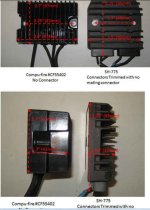
Both of those replacements are a bit bigger than stock. The Compufire is just a bit larger footprint, but considerably taller. The Polaris is a considerably larger footprint, but about the same height. Either one might need a little fabrication to mount it, and might even need a new location.

.
 
SERIES_RR_Size.jpg

here are some nominal dimension; teh SH775 is with a trimmed shroud and no mating connector.

Are you really dead-set on getting the Compufire or would you like a similar R/R that costs about half as much? :-k

The cheapest that I have seen a (new) Compufire sell for is about $150. The SH775 R/R from Polaris can be bought for about $70, plus shipping.

Both of those replacements are a bit bigger than stock. The Compufire is just a bit larger footprint, but considerably taller. The Polaris is a considerably larger footprint, but about the same height. Either one might need a little fabrication to mount it, and might even need a new location.

.
 
Kool_aid kid, where do you get these bimetal breaker/fuse's at, sounds like a good safe guard for anyones system, at least worth a try. Thanks JD
 
Back
Top