• Required reading for all forum users!!!

    Welcome!
    Register to access the full functionality of the GSResources forum. Until you register and activate your account you will not have full forum access, nor will you be able to post or reply to messages.

    A note to new registrants...
    All new forum registrations must be activated via email before you have full access to the forum.

    A Special Note about Email accounts!
    DO NOT SIGN UP USING hotmail, outlook, gmx, sbcglobal, att, bellsouth or email.com. They delete our forum signup emails.

    A note to old forum members...
    I receive numerous requests from people who can no longer log in because their accounts were deleted. As mentioned in the forum FAQ, user accounts are deleted if you haven't logged in for the past 6 months. If you can't log in, then create a new forum account. If you don't get an error message, then check your email account for an activation message. If you get a message stating that the email address is already in use, then your account still exists so follow the instructions in the forum FAQ for resetting your password.

    Have you forgotten your password or have a new email address? Then read the forum FAQ for details on how to reset it.

    Any email requests for "can't log in anymore" problems or "lost my password" problems will be deleted. Read the forum FAQ and follow the instructions there - that's what we have one for...

  • Returning Visitors

    If you are a returning visitor who never received your confirmation email, then odds are your email provider is blockinig emails from our server. The only thing that can be done to get around this is you will have to try creating another forum account using an email address from another domain.

    If you are a returning visitor to the forum and can't log in using your old forum name and password but used to be able to then chances are your account is deleted. Purges of the databases are done regularly. You will have to create a new forum account and you should be all set.

How many inches of vacuum?

  • Thread starter Thread starter rthor
  • Start date Start date
R

rthor

Guest
I'm doing a sync on a VM carb (78 GS550). I've pulled the carbs, done a thorough cleaning and got a baseline bench sync. The engine starts up without any difficulty. I hooked up my homemade sync tool (with a single needle guage hooked up to a 4-way valve) and am getting a range of readings around the 5 inch mark (at idle). In previous posts I have read that the carbs should pull an even 7 or 8 inches at 1200 RPM. Is this about where I should set them? I've also read that the it's best to synchronize the at higher RPMs. One post I read stated that the carbs should pull 25 inches of vacuum at 2000 RPM. I kind of confused here...doesn't the vacuum level drop with the increased RPM?
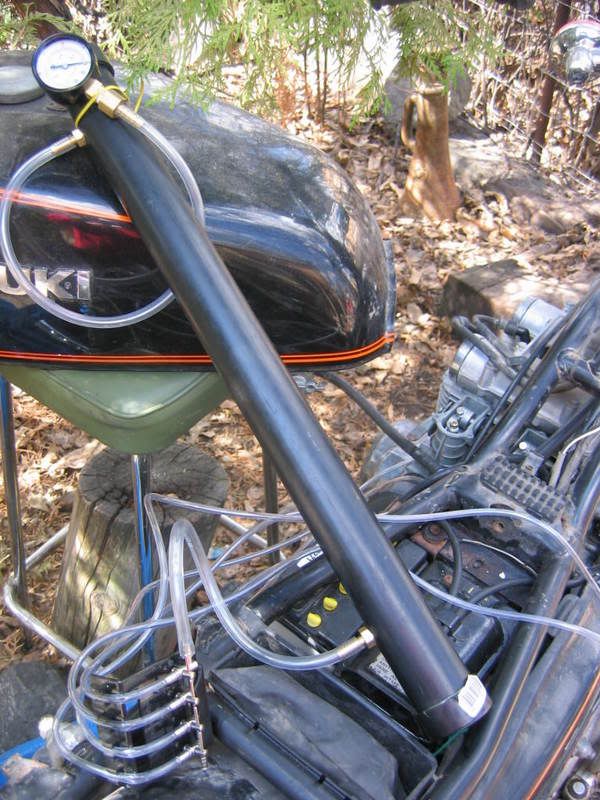
IMG_0972.jpg
 
Very interesting setup, there. I am presuming that the black pipe is used as a damper chamber? You really don't need it. Let the needle bounce a bit, the quick reaction time will be worth it.

In previous posts I have read that the carbs should pull an even 7 or 8 inches at 1200 RPM. Is this about where I should set them?
The actual reading does not matter nearly as much as having them all the same. The only exception I have seen to this is that if you have stock exhaust, the middle two cylinders should go about 1/2 cm (1/4 inch) lower. I have heard conflicting stories on why you do this. Some say to compensate for the crossover tube in the exhaust, others say to give the middle two cylinders just a little more fuel, which will help with cooling. I don't know which, if either, is correct.

I've also read that the it's best to synchronize the at higher RPMs.
I have always done mine at idle speed, but checked for differences while slowly increasing the rpm. I look for a smooth idle and smooth response off the line. The Suzuki manual states to do the sync at 1700 rpm.

One post I read stated that the carbs should pull 25 inches of vacuum at 2000 RPM. I kind of confused here...doesn't the vacuum level drop with the increased RPM?
Vacuum level is a measure of how much air the engine is trying to move and how much the throttle plates are allowing. With no load (bike in neutral, not moving), if you run the engine speed up, it does not take much throttle opening to hold at 2000. Vacuum reading will be rather high, but I don't know if it will be 25 inches. Try the same thing in third gear, going up a hill, the vacuum reading will be very close to ZERO because the throttle plates will be wide open, trying to keep the engine at 2000 rpm.

Again, the actual readings don't mean nearly as much as whether they are all the same.


.
 
One post I read stated that the carbs should pull 25 inches of vacuum at 2000 RPM.

No way. Maybe the vacuum on a Chevy small block, but not a GS. My vacuum changes very little at increased RPM. My 850 is usually around 10" even, but what's important is that they are all the same as previously stated.
 
My exhaust seems to be stock but there is no cross-over tube so I'll just dial them all in at the same level, somewhere around 8 - 10 inches at 1700 RPM.
BTW, I got the idea for the sync tool from an earlier thread on this site. The PVC tube does eliminate the bouncing needle reading, and yes, there is a slight delay in getting the full reading. I'd have to say though, I'm pretty impressed with its overall design and it does the job.
As for the 25 inches of mercury, maybe the poster of that thread was meaning to say 25cm. Anyway, that clears things up nicely.
Thanks for the technical support.
 
Since you have to do each carb one at a time, have you found it difficult to adjust all four carb to have the same vacuum level? I was thinking about this same design a while back (I made a few posts about it) but then opted for another design that didn't quite work so well. If you have positive results, please let me know and I'll prob end up going this route as well. Take care.
 
You can't accurately adjust your VM carbs one at a time because any slight over-adjustment at one carb will effect the level of the others. They're all connected to the same shaft. Pin one down just a bit and it lifts the shaft and changes the other three levels.
Try it sometime for fun. Adjust one the way you want it. Now adjust the next one. Go just a bit too far and it will effect the level of the one you just adjusted along with the others. Without a gauge that shows you what all four are doing at the same time, you can't accurately match them.
 
I will not refute that statement Kieth. The method I'm using is more in the fashion of "hit and miss" than "bang-on." And it probably takes at least four times as long than doing it with the proper set-up. I have no intention of promoting this method, but it does get a read off of each carb and it does tell me what I want to know. One of these days I'll invest in proper guages and do the job with more precision. But for what it's worth, (probably 15 bucks total) this is a pretty nifty tool.
 
You're dead on there Keith. I would even go so far as to say everytime an adjustment is made to one carb, the levels in the other three will change.
The problem is there is no set sequence to adjustment. The sequence is dictated by the degree of change of each carb which doesnt remain constant. There is no way to know the correct order of adjustment if you have no idea what the vacuum level is on on four simultaneously.

E.


You can't accurately adjust your VM carbs one at a time because any slight over-adjustment at one carb will effect the level of the others. They're all connected to the same shaft. Pin one down just a bit and it lifts the shaft and changes the other three levels.
Try it sometime for fun. Adjust one the way you want it. Now adjust the next one. Go just a bit too far and it will effect the level of the one you just adjusted along with the others. Without a gauge that shows you what all four are doing at the same time, you can't accurately match them.
 
Vacuum level is a measure of the velocity of the airflow. Volume is a function of displacement and rpm. Vacuum remains relatively constant throughout the engine rpm range. Momentary highs and lows in the level occur with abrupt throttle changes but once the engine has acclimated to the new power level, vacuum resumes the same level. Vacuum cannot drop to zero when traveling up a hill. If there were no vacuum, then no fuel could reach the intakes. The throttle plates move in relation to velocity management. As rpm increases, volume increases. For the velocity to remain constant, the throttle plates must open, allowing a larger throughflow area. Vacuum consequently remains constant. CV carbs are constant velocity carbs. A properly adjusted set of VM carbs (mechanical slide/throttle priority) will maintain the same constant vacuum condition as the "automatic" CV carbs.


Earl


Steve [COLOR=blue said:
Vacuum level is a measure of how much air the engine is trying to move and how much the throttle plates are allowing. With no load (bike in neutral, not moving), if you run the engine speed up, it does not take much throttle opening to hold at 2000. Vacuum reading will be rather high, but I don't know if it will be 25 inches. Try the same thing in third gear, going up a hill, the vacuum reading will be very close to ZERO because the throttle plates will be wide open, trying to keep the engine at 2000 rpm.[/color]

Again, the actual readings don't mean nearly as much as whether they are all the same.


.
 
Back
Top