• Required reading for all forum users!!!

    Welcome!
    Register to access the full functionality of the GSResources forum. Until you register and activate your account you will not have full forum access, nor will you be able to post or reply to messages.

    A note to new registrants...
    All new forum registrations must be activated via email before you have full access to the forum.

    A Special Note about Email accounts!
    DO NOT SIGN UP USING hotmail, outlook, gmx, sbcglobal, att, bellsouth or email.com. They delete our forum signup emails.

    A note to old forum members...
    I receive numerous requests from people who can no longer log in because their accounts were deleted. As mentioned in the forum FAQ, user accounts are deleted if you haven't logged in for the past 6 months. If you can't log in, then create a new forum account. If you don't get an error message, then check your email account for an activation message. If you get a message stating that the email address is already in use, then your account still exists so follow the instructions in the forum FAQ for resetting your password.

    Have you forgotten your password or have a new email address? Then read the forum FAQ for details on how to reset it.

    Any email requests for "can't log in anymore" problems or "lost my password" problems will be deleted. Read the forum FAQ and follow the instructions there - that's what we have one for...

  • Returning Visitors

    If you are a returning visitor who never received your confirmation email, then odds are your email provider is blockinig emails from our server. The only thing that can be done to get around this is you will have to try creating another forum account using an email address from another domain.

    If you are a returning visitor to the forum and can't log in using your old forum name and password but used to be able to then chances are your account is deleted. Purges of the databases are done regularly. You will have to create a new forum account and you should be all set.

Tube for thought

  • Thread starter Thread starter sharpy
  • Start date Start date
S

sharpy

Guest
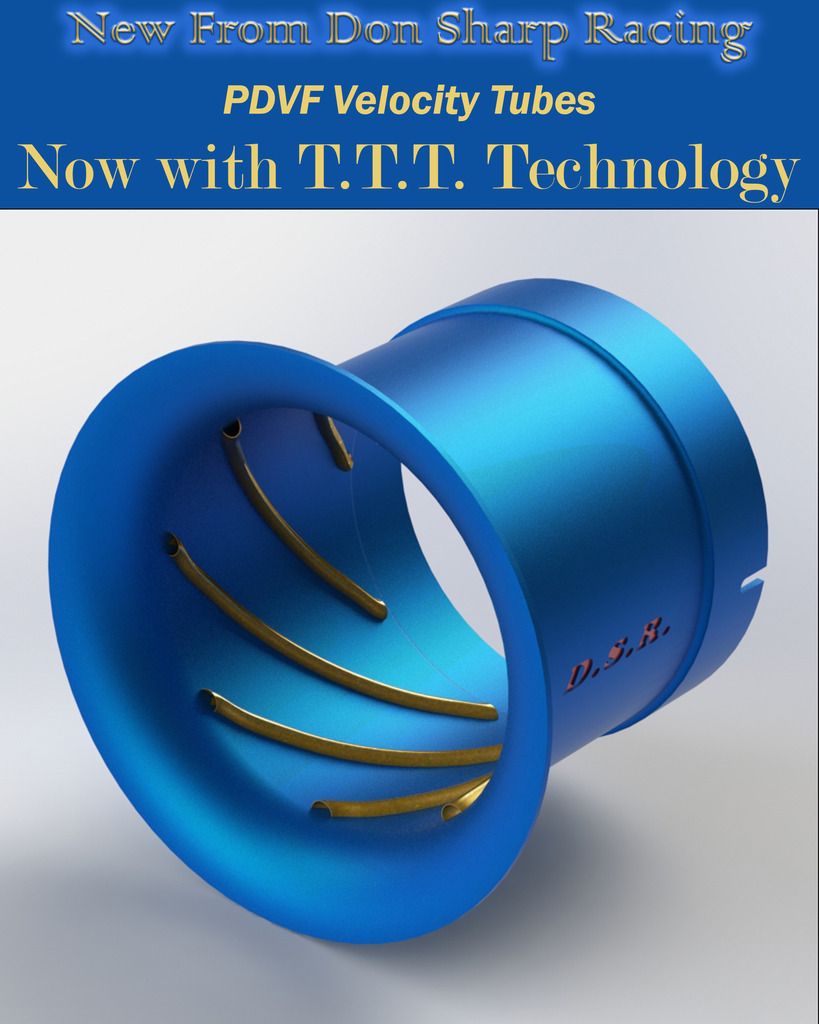
Was showing some people today and we cant decide if this be wierd or wonderful as a "improvement" So where is ray, posplayr and others for there comment. Ribs are actually tubes. Be nice now. FYI. i was totally bored yesterday, hence this drawing lol P.S. Dont take this too seriously

 
Last edited:
Looks like an attempt to get the flow to spiral into the throat of the carb to create a vortex. Not sure why that would create more flow, but might improve mixture at low flow.

In contrast, a venturi (decreasing cross section) by first principles creates increased flow in proportion to the reduced cross sectional area.

I'm not going to say, it doesn't do anything, but I would be surprised if you could tell by the butt dyno if it were installed or not.

The fact the tubes are hollow, probably means nothing as there is too much back pressure(from the small diameter) for anything to even flow through those tubes v.s. the
open flow in the center.

I have a huge 440 ci engine in an old motro home. I bought a similar device to this. I don't remember it doing anything to power or MPG. I did get a remarkable 15% increase with a Jacobs ignition though!!!

http://www.globalautoshop.com/performance/intake/vortex.htm

http://www.offroaders.com/reviewbox/showproduct.php?product=255

https://www.tornadoair.com/
 
Last edited:
we used swirl cups on turbines to help in flame direction/centering(with aid of bleed air) and atomization....can't really see a need on a natural asp using a carb... not like the flame needs to be centered. A venturi would pull more of a vacuum from the lower cross but this I can't see a benefit .... maybe a less than 5% gain...it would keep any back flow from going back into the air box....

benefits: more throat noise, extremely small gain/boost 0-5% if any. would need a jet that would help atomize better though. The tubes being raised do cause a pinch point for the air. try recessing them with the same pattern.

good thought on a velocity stack.

If you recess the "tubes"... will need to adjust the entire intake/carb to account for air flow, can't use the standard sized horn........ dam you for making me think. a fuel injected would probably be an easier adjust.
 
Last edited:
"The tubes being raised do cause a pinch point for the air. try recessing them with the same pattern." Recessing in what way? Smaller you mean, or have a indent in the middle along there length. And yes, im only stuffing around but us normal people couldn't work out if it would be better or worse. And a tapered velocity stack works better, if what i read was correct Oh, and these drawing would fit the 33mm Mikuni smooth-bores. Just a reference i used.

 
Last edited:
How are you machining these? It must be a pretty fancy CNC machining centre.
 
"The tubes being raised do cause a pinch point for the air. try recessing them with the same pattern." Recessing in what way? Smaller you mean, or have a indent in the middle along there length. And yes, im only stuffing around but us normal people couldn't work out if it would be better or worse. And a tapered velocity stack works better, if what i read was correct Oh, and these drawing would fit the 33mm Mikuni smooth-bores. Just a reference i used.

By raising the tubes you think you are adding more room but you are actually reducing the surface area for the air to flow, by recessing or grooves, you are increasing the surface area and not creating an air pinch point of flow. Raised tubes will cause more turbulence at the entry to the horn, recessed tubes will allow a smoother flow and create a vacuum at the entrance to the horn. The air pressure will increase at the point it enters the horn and flow into an increased volume area creating a lower pressure once inside the horn but the air will pick up velocity...again...I can't see any significant benefits.
 
Last edited:
By raising the tubes you think you are adding more room but you are actually reducing the surface area for the air to flow, by recessing or grooves, you are increasing the surface area and not creating an air pinch point of flow. Raised tubes will cause more turbulence at the entry to the horn, recessed tubes will allow a smoother flow and create a vacuum at the entrance to the horn. The air pressure will increase at the point it enters the horn and flow into an increased volume area creating a lower pressure once inside the horn but the air will pick up velocity...again...I can't see any significant benefits.

A lot easier to press the recesses in rather than solder on tubes.
 
A lot easier to press the recesses in rather than solder on tubes.

true, also, this would have to be a completely matched/tuned system as in finely tuned.... maybe on a racing superbike it might see an improvement...at that point, yes configuring an intake boot to match would aid in getting the most bang out of the cycle. For every day drivers we won't really see an improvement. Fuel injected models would be served well with a new atomization system, but again, for every day riders to see an advantage is slim...would have to be the racers with money.


On the venturi model... where you see this applied is in the Dyson vacuum cleaners and peri-jet eductors air/water...same principle... the philosophy is that you can get put in 1 and get 9 more. input 1 output 10 ( yes looks weird math but it's right ) if you put in 150 you get out 1500 put in 10 get 100, you have to account for what you put in because its coming out too.. your air inlet could theoretically be smaller, but box would have to be able to handle the required air flow.

You could go from (made up numbers here) a half dollar size horn to a penny sized horn with venturi jets in or around it forming an air eductor and get more air into the system... Kind of a "simple jet engine" principle.... however, no continuous combustion to handle the air and fuel flow that would be required.

In turn.... recessed easier to manufacture, looks cool, provided minimal improvements on basic bikes.

forgot, some of the new jet ski/ski-doo's use an eductor jet for their propulsion now.
 
Last edited:
So this is what im gathering. For a minimal gain. Food for thought


Similar, round the grooves... this should give sufficient air flow and the right turbulence for a regular bike. For a high performance bike, idle RPM's will suck but at high RPM's you could get extremely high efficiency due to the air flow/turbulence, gas atomization and high mix rate going into the combustion chamber for the big bang.... the question would be, if you get it too right, do you need a more bullet proof engine?

swirl control has been around a while in car engines and has been proven to increase economy and power, smoother effective turbulence in the combustion chamber is the goal...get the air and fuel mixed as much as possible. a serious re-jet would be in order....maybe even a carb mod.

On my 450... I would never notice the change lol
 
Last edited:
true, also, this would have to be a completely matched/tuned system as in finely tuned.... maybe on a racing superbike it might see an improvement...at that point, yes configuring an intake boot to match would aid in getting the most bang out of the cycle. For every day drivers we won't really see an improvement. Fuel injected models would be served well with a new atomization system, but again, for every day riders to see an advantage is slim...would have to be the racers with money.


On the venturi model... where you see this applied is in the Dyson vacuum cleaners and peri-jet eductors air/water...same principle... the philosophy is that you can get put in 1 and get 9 more. input 1 output 10 ( yes looks weird math but it's right ) if you put in 150 you get out 1500 put in 10 get 100, you have to account for what you put in because its coming out too.. your air inlet could theoretically be smaller, but box would have to be able to handle the required air flow.

You could go from (made up numbers here) a half dollar size horn to a penny sized horn with venturi jets in or around it forming an air eductor and get more air into the system... Kind of a "simple jet engine" principle.... however, no continuous combustion to handle the air and fuel flow that would be required.

In turn.... recessed easier to manufacture, looks cool, provided minimal improvements on basic bikes.

forgot, some of the new jet ski/ski-doo's use an eductor jet for their propulsion now.

I did a little thinking about this and realize what the physical property is.

We already discussed the venturi effect which is traditionally used in carburation. As the throat necks down the flow has to increase and the pressure drops. However, there is nothing that says that the velocity(vector direction) and the pressure(scalar) are related. So if you can add more velocity on top of the velocity through the neck you can get more pressure drop and more flow.

That additional velocity is through the rotating vortex which is essentially at right angles to the axial flow so the net is a cork screw of flow, with apparently much lower pressure. That Is if the receiving side will support the flow.

https://www.google.com/imgres?imgur...aPyvNFbfmGYIcM:&tbnh=141&tbnw=211&vet=1&w=600
 
I did a little thinking about this and realize what the physical property is.

We already discussed the venturi effect which is traditionally used in carburation. As the throat necks down the flow has to increase and the pressure drops. However, there is nothing that says that the velocity(vector direction) and the pressure(scalar) are related. So if you can add more velocity on top of the velocity through the neck you can get more pressure drop and more flow.

That additional velocity is through the rotating vortex which is essentially at right angles to the axial flow so the net is a cork screw of flow, with apparently much lower pressure. That Is if the receiving side will support the flow.

https://www.google.com/imgres?imgur...aPyvNFbfmGYIcM:&tbnh=141&tbnw=211&vet=1&w=600

bingo, in the gas turbine world, we move enough air to create clouds in our intakes and ice at 60 degrees....it's a beautiful thing to see an intake chamber ice the windows up and the outside air is 70. being able to direct/control the flow and pressures of air is essential. I'm sure you have seen the "Flame Light Saber" videos... same thing.... controlling the flame with a swirling curtain of air or what ever propellant they happen to use with the fuel ignited and swirling in the center. Being able to force more "cool" air into the chamber with a higher mix rate = bigger bang. How do we do it... increase the surface area so more air can come in. hence the grooves, the turbulence will happen on it's own, is just nice to try and direct it to the right place with the highest effect.

not to be an SA, that equation isn't the right one, but in the same ballpark of equations... I knew what you were saying. Stop making me think.....I gave this up 5 years ago lol. I just wanna be a knuckle dragging mech.
 
Last edited:
I get involved in aerodynamic (and fluid dynamics) from time to time.

Usually it's issues surrounding accuracy on fiscal metering stations involving ultrasonic,coriolis and orifice based technologies.

to cut a long story short ... you need to think about laminar flow, vortex induced swirl and ,with those strakes, the impact of vortex shear on turbulence ( part of von karman street vortex issues).

Essentially, the strakes may throw numerous small vortices into the flow path which could be useful in the event of harmonic resonance but may actually slow down the velocity ..... might improve fuel air mixing though

tnen again - its late, I'm tired and none of this may apply :rolleyes:
 
I get involved in aerodynamic (and fluid dynamics) from time to time.

Usually it's issues surrounding accuracy on fiscal metering stations involving ultrasonic,coriolis and orifice based technologies.

to cut a long story short ... you need to think about laminar flow, vortex induced swirl and ,with those strakes, the impact of vortex shear on turbulence ( part of von karman street vortex issues).

Essentially, the strakes may throw numerous small vortices into the flow path which could be useful in the event of harmonic resonance but may actually slow down the velocity .....might improve fuel air mixing though

tnen again - its late, I'm tired and none of this may apply :rolleyes:

might improve fuel air mixing

The whole point in 5 words....outstanding.
 
I just blew my own mind..... DIMPLES .... like on a golf ball..... throughout the intake area. :mask: Turbulence would not allow any fuel to pool and would provide maximum mixture. would have to throughout the entire intake area.

just looked this up...it's already a thing.
 
Last edited:
Was showing some people today and we cant decide if this be wierd or wonderful as a "improvement"

I will go on record as saying this will do SFA overall, and very possibly be a negative. You can't get significant amounts of swirl with those tiny little ridges in the stack and it will introduce significant turbulence into the boundary layer along the walls, likely reducing the amount the stacks flow. The point of a velocity stack is to smooth the flow (ie - reduce turbulence) and allow more air in for any given pressure difference from atmospheric to the carb throat. This is working against that goal.

The second model with the grooves in the bore won't do anything at all regarding swirl as the air will simply pass over the grooves with no effect. It also shouldn't hurt anything, either.


That additional velocity is through the rotating vortex which is essentially at right angles to the axial flow so the net is a cork screw of flow, with apparently much lower pressure. That Is if the receiving side will support the flow.

My 1100E has an intake velocity of ~ 22m/s @ 9000rpm (assuming steady flow, 100% volumetric efficiency and 34mm carb bores). Because the total velocity vector will be the square root of the sum of the squares you will need an unobtainable amount of swirl to significantly lower the pressure beyond what it achieves without the swirl. To achieve a 1% increase in the total velocity over the 22m/s you need a tangential velocity (the swirl velocity) of 3.12m/s. In a 34mm bore that equates to a swirl of 1750RPM. And only the very outer portion of the bore achieves that much velocity increase, the rest drops off with the radius it is swirling at from the bore centerline.


to cut a long story short ... you need to think about laminar flow

Velocities in the stack will be high enough that the boundary layer should be fully turbulent before it ever gets to the carb throat itself.


If someone wants to do the fluids calcs to prove me right or wrong on the boundary layer, feel free. Also someone redoing my calcs for the intake velocity and swirl velocity would be welcome as well. As bsharpish says, it is a bit late.


Mark
 
Last edited:
I just blew my own mind..... DIMPLES .... like on a golf ball..... throughout the intake area. :mask: Turbulence would not allow any fuel to pool and would provide maximum mixture. would have to throughout the entire intake area.

just looked this up...it's already a thing.

IIRC, Golf ball dimples are used to convert laminar (smooth flow) to turbulent (chaotic flow) by "tripping the boundary layer". In boundary layer theory, turbulent flow has more energy and can stay attached to the ball longer as it flows around to the back of the ball. This reduces pressure drag. Pressure drag is not really present in a venturi.

On the other hand many guys that do head porting leave ports purposefully rough to improve flow mixing (i.e. turbulence). To a limit it is beneficial.

As pointed out already, trying to spin the flow with vaning or tubes or grooves will also create a certain amount of turbulence along with the axial vortex.

The bottom line is that if you try and create a vortex, you probably increase turbulence and flow at the same time. (some combination of better gas mileage and better power).

The one I bought years ago did not seem to do anything for my 440 4B, but others have reported benefits that could certainly be attributed to the vortex action.
 
Back
Top