• Required reading for all forum users!!!

    Welcome!
    Register to access the full functionality of the GSResources forum. Until you register and activate your account you will not have full forum access, nor will you be able to post or reply to messages.

    A note to new registrants...
    All new forum registrations must be activated via email before you have full access to the forum.

    A Special Note about Email accounts!
    DO NOT SIGN UP USING hotmail, outlook, gmx, sbcglobal, att, bellsouth or email.com. They delete our forum signup emails.

    A note to old forum members...
    I receive numerous requests from people who can no longer log in because their accounts were deleted. As mentioned in the forum FAQ, user accounts are deleted if you haven't logged in for the past 6 months. If you can't log in, then create a new forum account. If you don't get an error message, then check your email account for an activation message. If you get a message stating that the email address is already in use, then your account still exists so follow the instructions in the forum FAQ for resetting your password.

    Have you forgotten your password or have a new email address? Then read the forum FAQ for details on how to reset it.

    Any email requests for "can't log in anymore" problems or "lost my password" problems will be deleted. Read the forum FAQ and follow the instructions there - that's what we have one for...

  • Returning Visitors

    If you are a returning visitor who never received your confirmation email, then odds are your email provider is blockinig emails from our server. The only thing that can be done to get around this is you will have to try creating another forum account using an email address from another domain.

    If you are a returning visitor to the forum and can't log in using your old forum name and password but used to be able to then chances are your account is deleted. Purges of the databases are done regularly. You will have to create a new forum account and you should be all set.

Why does Suzuki split R/R + output between ignition and battery?

Thanks for the replies. Allow me to respond in order received:
bakalorz - If I do this, I will place a 20A fuse between the R/R and the battery. I also have an LED voltmeter which glows in different colours, according to the voltage:
Voltage
Output
>15.20
Green/Red alternating (over-voltage)
>13.20
Green (charging)
>12.45
Amber (75% plus)
>12.25
Red slow flash (50% approx)
>12.00
Red 2 flashes, repeat
>11.80
Red 3 flashes, repeat
<11.80
Red 4 flashes, repeat

I believe that the combination of these two safeguards will be sufficient safeguards to warn me if an overcharging occurs.
However, I believe you might be a bit confused. I am looking at a wiring diagram right now. If I go straight to the battery and the main fuse blows, the Battery no longer has power to supply to Ignition Switch, which cannot supply power to the other 3 fuses, and the engine dies, the bike shuts down, including the lights.
OTOH, if I keep it in the loop and the main fuse blows, the R/R is still supplying voltage to the Ignition Switch, which in turn supplies the other 3 fuses, so the bike keeps running. However, the R/R now believes the battery is severely undercharged and goes through the roof. And there is no fuse to protect the system any more. Please correct me if I am reading the diagram wrong.

Matchless, you are correct. In OEM configuration the supply from the R/R to the ignition switch is not fused. Please see previous reply.

OldVet66, you are correct. If the main fuse dies you are done.

Let me theorize a bit further if I may: In my TransAm I place relays everywhere it is very important to keep maximum power available. Each relay is fused in case things get out of hand. Where I really, really care, I also place a bimetal breaker in series with the fuse. If it overheats, the metals expand away from each other and the circuit broken. If I do this, there will be a bimetal breaker in place also.

I am really attempting to understand and grasp this circuit, so please LMK if I am mistaken in some area.
Thank you.

You have gotten deep enough into this that you should be using a schematic and askng questions about a schematic. Doing a failure modes analysis is the correct way to approach it (ask you self what happens if this shorts or that).

Right now you seem to have conviced yourself to put a 20 amp fuse between battery and R/R but it is not clear whether that is in the original OEM "T" configuration (which only requires 15 amp fuse) or the modified version that requires 20 amp and (tries) to goes around the stock fuze box?
 
You have gotten deep enough into this that you should be using a schematic and askng questions about a schematic. Doing a failure modes analysis is the correct way to approach it (ask you self what happens if this shorts or that).

Right now you seem to have conviced yourself to put a 20 amp fuse between battery and R/R but it is not clear whether that is in the original OEM "T" configuration (which only requires 15 amp fuse) or the modified version that requires 20 amp and (tries) to goes around the stock fuze box?
You are correct. Currently I am using schematics from a GS650, GS850 & VX800. All are slightly different, but all show:
a) A similar loop
b) Similar responses if the Ignition Switch is removed from the unfused loop.
I have drawn out each circuit by hand, and observed similar responses if that part of the loop is removed (theoretical only, of course). I use a 20A fuse because the output of the stator was rated a 230W back in 1981 http://www.cbxclub.com/davespage/mcy80-11.html, and I have seen no changes that would indicate a larger power output. The modified version does not actually go around the stock fuse box, rather it uses only the stock fuse box. The OEM design goes around the stock fuse box by also wiring in directly to the Ignition Switch, unfused. I have not yet examined the 1100E wiriing diagram, because it will be my final analysis machine, but I expect it to be similar.
I have also done a theoretical failure modes analysis (on paper, of course). All show the main fuse blowing and the bike stopping. The unfortunate part is that if you are on HWY 1 and the fuse blows, you stop. Which could really suck.
What I have not done (yet) is the analysis of running this much power along one tiny 18-gauge wire instead of two.
Another theory could be history. Observe the stator headlight loop. Is this Ignition Switch loop another history lesson, we always did it that way and it would cost money to change it? IDK, perhaps an examination of a T200, T250 or T500 is in order. At some point in time an engineer convinced a manager, who convinced a committee, who convinced a bean counter that this is the correct way to do it. We both know how the system works. Once in place, it is another difficult task to convince them to change.
IDK, which is why I am asking questions. The thirst for knowledge runs deep in an engineer, as you know. I am just delving into the "Yes, but WHY" part.
 
I have also done a theoretical failure modes analysis (on paper, of course). All show the main fuse blowing and the bike stopping.


It seems to me the bike WILL keep running even if the main fuse blows with the T-loop in place, but it won't if the R/R output runs straight to the battery. This thread has convinced me to keep the T-loop in place.

As an aside, my bike is setup with the factory "accessory" fuse feeding power to the coil relay mod. The stator wires feed directly into the R/R (bypassing the headlamp loop) and one of those flashing LED voltage meters are hooked up to the output side of the coil relay so the charging system can be monitored.

The output of the R/R is 14.5 volts, but the voltage at the main and accessory fuses was only 13.8 - 14.0 volts or so and the flashing LED was showing a lot of RED (not charging properly). Measured resistance though the fuse block and there isn't any so I conclude the system draw is using up some of the available power. I wound up installing a new battery and a series R/R and now the LED is showing GREEN like it should, but I'm wondering how long it will last.


.
 
Last edited:
It almost seems like a Catch 22. If the loop is in place it should stay running. However, now the R/R is trying like crazy to charge a non-existent battery. If the loop is removed, you run the risk of stopping on a 70 mph freeway, unless you designed in a "go-back" circuit, but I doubt you would be able to trigger it without stopping first.
I have an LED voltmeter ready to install; I believe it was you that recommended it. The voltage levels it triggers at seem a bit questionable, but it is better than nothing at all.
 
You are correct. Currently I am using schematics from a GS650, GS850 & VX800. All are slightly different, but all show:
a) A similar loop
b) Similar responses if the Ignition Switch is removed from the unfused loop.
I have drawn out each circuit by hand, and observed similar responses if that part of the loop is removed (theoretical only, of course). I use a 20A fuse because the output of the stator was rated a 230W back in 1981 http://www.cbxclub.com/davespage/mcy80-11.html, and I have seen no changes that would indicate a larger power output. The modified version does not actually go around the stock fuse box, rather it uses only the stock fuse box. The OEM design goes around the stock fuse box by also wiring in directly to the Ignition Switch, unfused. I have not yet examined the 1100E wiriing diagram, because it will be my final analysis machine, but I expect it to be similar.
I have also done a theoretical failure modes analysis (on paper, of course). All show the main fuse blowing and the bike stopping. The unfortunate part is that if you are on HWY 1 and the fuse blows, you stop. Which could really suck.
What I have not done (yet) is the analysis of running this much power along one tiny 18-gauge wire instead of two.
Another theory could be history. Observe the stator headlight loop. Is this Ignition Switch loop another history lesson, we always did it that way and it would cost money to change it? IDK, perhaps an examination of a T200, T250 or T500 is in order. At some point in time an engineer convinced a manager, who convinced a committee, who convinced a bean counter that this is the correct way to do it. We both know how the system works. Once in place, it is another difficult task to convince them to change.
IDK, which is why I am asking questions. The thirst for knowledge runs deep in an engineer, as you know. I am just delving into the "Yes, but WHY" part.

The way the wiring system is designed is not a bean counter or commitee thing. It is the right way to do it ! :!:

The reason is that this in not simply a continuous DC circuit; it is a DC circuit with significant alternating currents superimposed on it as the R/R provides current to the circuit from the stator, and then shunts the stator. This goes on in a continous cycle, and the OEM Suzuki wiring minimizes the amount of wiring the overall currents have to traverse.

To get a better idea of what the actual currents are you can look at what I wrote in post #24 of posplayrs charging contest (and for more detail than you could possibly want look towards the end of that thread)
 
Thanks for the link. Post #24 looks interesting; I'll have to start at the beginning. I appreciate it.
 
It seems to me the bike WILL keep running even if the main fuse blows with the T-loop in place, but it won't if the R/R output runs straight to the battery. This thread has convinced me to keep the T-loop in place.

As an aside, my bike is setup with the factory "accessory" fuse feeding power to the coil relay mod. The stator wires feed directly into the R/R (bypassing the headlamp loop) and one of those flashing LED voltage meters are hooked up to the output side of the coil relay so the charging system can be monitored.

The output of the R/R is 14.5 volts, but the voltage at the main and accessory fuses was only 13.8 - 14.0 volts or so and the flashing LED was showing a lot of RED (not charging properly). Measured resistance though the fuse block and there isn't any so I conclude the system draw is using up some of the available power. I wound up installing a new battery and a series R/R and now the LED is showing GREEN like it should, but I'm wondering how long it will last.


.

Ed,
I just happened on to the thread again while looking for 4:1 dyno results thread. Any updates from when you posted the above?


I also had my ED electrical coil relay mod wired as you described and powered using the fused accessory. Later when I opened up my harness, I moved the relay power to the "T" location and put a 10 amp in line fuse.

I also wired in a accessory plug with additional inline fuse mounted on the handlebar for IPhone and battery charger. It is also wired into the "T:.

Jim
 
I did a side by side compare of the OEM R/R to battery wiring and a comparison to the "popular" way people hook up new R/R and go "direct to the battery". I'm making some assumptions here as I think people normally only add one additional inline fuse. So with that here is a side by side compare.

Bakalorz has also brought up the issue of the high speed current switching that goes on depending upon whether the R/R is sourcing current or not. What that means is when the R/R is not sourcing current it is identical to the condition that I show with engine off so that point is considered in this analysis. The average currents (as measured) remain unchanged as they take the current switching into account.

Bottom line is to stick to the way Suzuki designed it in the first place. This is something they did get right.


WIRING_COMPARE_1_zps28b00232.jpg


WIRING_COMPARE_2_zps0e7eb003.jpg


WIRING_COMPARE_3_zps591bfacc.jpg
 
Last edited:
I did a side by side compare of the OEM R/R to battery wiring and a comparison to the "popular" way people hook up new R/R and go "direct to the battery". I'm making some assumptions here as I think people normally only add one additional inline fuse. So with that here is a side by side compare.

Bakalorz has also brought up the issue of the high speed current switching that goes on depending upon whether the R/R is sourcing current or not. What that means is when the R/R is not sourcing current it is identical to the condition that I show with engine off so that point is considered in this analysis. The average currents (as measured) remain unchanged as they take the current switching into account.

Bottom line is to stick to the way Suzuki designed it in the first place. This is something they did get right.

Interesting. I was just about to order some stuff from Eastern Beaver to install my SH775 regulator. (Why are Furukawa connectors so hard to find and/or out of stock everywhere? Grumble, snarl...). My stator to regulator wiring was cooked, including a melted connector, but the positive wire into the harness looks OK. The regulator on the bike now is an almost new Electrosport which is connected directly to the stator with bullet connectors (shiny new and clean). Because the bike is in pieces for other reasons I bought the SH775 from my local Polaris dealer to upgrade my electrics.

So your recommendation for installation is to keep the T. Searching shows this this has been debated before.

Regulator +ive to the harness (solder or shiny new connector).
Regulator negative to the battery or good frame ground (shiny new ring connector).
Stator connected directly to the regulator (solder or shiny new connectors). I might use new bullets to match what is already on the stator.

Thanks.

Jim
 
Ed,
I just happened on to the thread again while looking for 4:1 dyno results thread. Any updates from when you posted the above?


I also had my ED electrical coil relay mod wired as you described and powered using the fused accessory. Later when I opened up my harness, I moved the relay power to the "T" location and put a 10 amp in line fuse.

I also wired in a accessory plug with additional inline fuse mounted on the handlebar for IPhone and battery charger. It is also wired into the "T:.

Jim


Jim,

Using your updated Stator Paper's guide figured out there was voltage loss between the R/R positive output wire and the battery. Cleaned the brass terminals in the circuit by extracting them from the connector shell and dunking them in acid. Pinched down the female prongs on the terminals and reassembled everything back together. Voltage loss went from more than 1/2 volt down to about 1/8 volt (can't remember exactly). Stupid flashing LED volt meter still doesn't work properly, but the charging system seems to be.
 
Interesting. I was just about to order some stuff from Eastern Beaver to install my SH775 regulator. (Why are Furukawa connectors so hard to find and/or out of stock everywhere? Grumble, snarl...). My stator to regulator wiring was cooked, including a melted connector, but the positive wire into the harness looks OK. The regulator on the bike now is an almost new Electrosport which is connected directly to the stator with bullet connectors (shiny new and clean). Because the bike is in pieces for other reasons I bought the SH775 from my local Polaris dealer to upgrade my electrics.

So your recommendation for installation is to keep the T. Searching shows this this has been debated before.

Regulator +ive to the harness (solder or shiny new connector).
Regulator negative to the battery or good frame ground (shiny new ring connector).
Stator connected directly to the regulator (solder or shiny new connectors). I might use new bullets to match what is already on the stator.

Thanks.

Jim

You missed the Single point grounding posts.

See GS Charging Health.

http://www.thegsresources.com/_forum/showthread.php?t=152769&highlight=charging+system+health

By picking one of the R/R mounting bolts as the single point ground point, the
R/R(-) wire can be very short, the mounting plate is automatically grounded and
all of the return current wires can be tied securely together at a single point. Here
are the connections
• #1: Ground R/R(-) to case and side plate
• #2: The shortest wire to a frame bolt
• #3: The shortest wire to the Battery (-)
• #4: Connects to the (B/W) harness negative ring lugs (typically the one
attached at the solenoid mounting bolt). You can leave the other harness
ground ring lug (B/W) where it normally is picking up the battery box
ground.
 
Last edited:
Jim,

Using your updated Stator Paper's guide figured out there was voltage loss between the R/R positive output wire and the battery. Cleaned the brass terminals in the circuit by extracting them from the connector shell and dunking them in acid. Pinched down the female prongs on the terminals and reassembled everything back together. Voltage loss went from more than 1/2 volt down to about 1/8 volt (can't remember exactly). Stupid flashing LED volt meter still doesn't work properly, but the charging system seems to be.

Ed,
Most of these connections have very low resistance, but it does not take much to create the voltage drops. It is just not that easy to measure 0.1 ohms resistance but 0.5V is not hard to miss. My thoughts are that with 0.25V there is some definite resistance somewhere due to corrosion and going unchecked it will likely only increase. By driving the voltage drop down to 0,.1V and below then you are giving yourself more time for corrosion to set back in.

Good job.
Jim


P.S.
Here is a thread where the OP diligently went through chasing down all of the connections and retested as he made progress. You can see how charging voltages and voltages to the coils steadily increased as he drove down the voltages between the R/R and battery. Last he posted he still needed to go after the positive battery connection.

http://www.thegsresources.com/_forum/showpost.php?p=1907847&postcount=23
 
Last edited:


Good point. The regulator on the GS650G is bolted to a metal panel that also holds the ignitor. The panel is then bolted to the frame behind the battery box so there is an extra bolt between the regulator and the frame. The regulator sits horizontally and the mounting bolts are vertical and hard to access unless you are lying under the bike looking up.

I figured the best frame ground was the grounding point under the battery box because it is connected directly to the frame. I could also use the bolt on the other side of the battery box. I will need to figure out which option uses the least wire and is most convenient for inspection and cleaning.

I have already removed any existing frame grounds and cleaned the terminals and frame with Deoxit and a wire brush.

Jim
 
Good point. The regulator on the GS650G is bolted to a metal panel that also holds the ignitor. The panel is then bolted to the frame behind the battery box so there is an extra bolt between the regulator and the frame. The regulator sits horizontally and the mounting bolts are vertical and hard to access unless you are lying under the bike looking up.

Jim
If you remove battery you'll see the airfilter box is held on to frame by two bolts facing you- the lower one at front is the ideal spot for a common ground point. Run one ground wire up to ignitor and R/r plate, run another direct to battery negative; Depending on your R/R, best to have its ground wire here also. I also add a ground wire from here up to a bolt holding the fuse box to frame to aid headlight power.
 
Good point. The regulator on the GS650G is bolted to a metal panel that also holds the ignitor. The panel is then bolted to the frame behind the battery box so there is an extra bolt between the regulator and the frame. The regulator sits horizontally and the mounting bolts are vertical and hard to access unless you are lying under the bike looking up.

I figured the best frame ground was the grounding point under the battery box because it is connected directly to the frame. I could also use the bolt on the other side of the battery box. I will need to figure out which option uses the least wire and is most convenient for inspection and cleaning.

I have already removed any existing frame grounds and cleaned the terminals and frame with Deoxit and a wire brush.

Jim

The electrical panel and/or battery box on many GS's is rubber mounted, so the ground path goes through the little metal spacers in the center of the grommets. Basically a really bad grounding path. It's much better to run a ground jumper from the R/R to a solid frame point or the battery directly.
 
The electrical panel and/or battery box on many GS's is rubber mounted, so the ground path goes through the little metal spacers in the center of the grommets. Basically a really bad grounding path. It's much better to run a ground jumper from the R/R to a solid frame point or the battery directly.

It's much better to run a ground jumper from the R/R to a solid frame point AND the battery directly.

tying both as close to the R/R as possible (close means a short R/R(-) wire
 
SO this is news to me. I had my Compufire wired directly to the battery.
So I should pare back my negative wire on my Compufire as short as possible to the battery negative terminal.
I should then connect the positive wire on my Compufire to the original red wire that connected the OEM reg\rect?
 
Jim has been talking about this for some time. He convinced me so I changed back from direct battery feed to the stock Suzuki feed for the Compu-Fire. To tell the truth I did not notice any difference so I'm wondering why I went directly to the battery in the first place. It must have been the nice inline fuse holder that confused the issue.
 
What about the fuse?

What about the fuse?

SO this is news to me. I had my Compufire wired directly to the battery....I should then connect the positive wire on my Compufire to the original red wire that connected the OEM reg\rect?

Me too. That's what I am going to do, I have been reading various PosPlayr posts and I noticed you hadn't heard back yet here either. I'd also like to know if it is recommended to fuse it, or keep it like the original R&R was, which wasn't fused. Either way, I will wire it as close to the harness "T" as possible, not down by the connector to the OEM R&R.

...I'm wondering why I went directly to the battery in the first place. It must have been the nice inline fuse holder that confused the issue.

For me it was the nice inline fuse holder (albeit with no lid or cap!) and this:

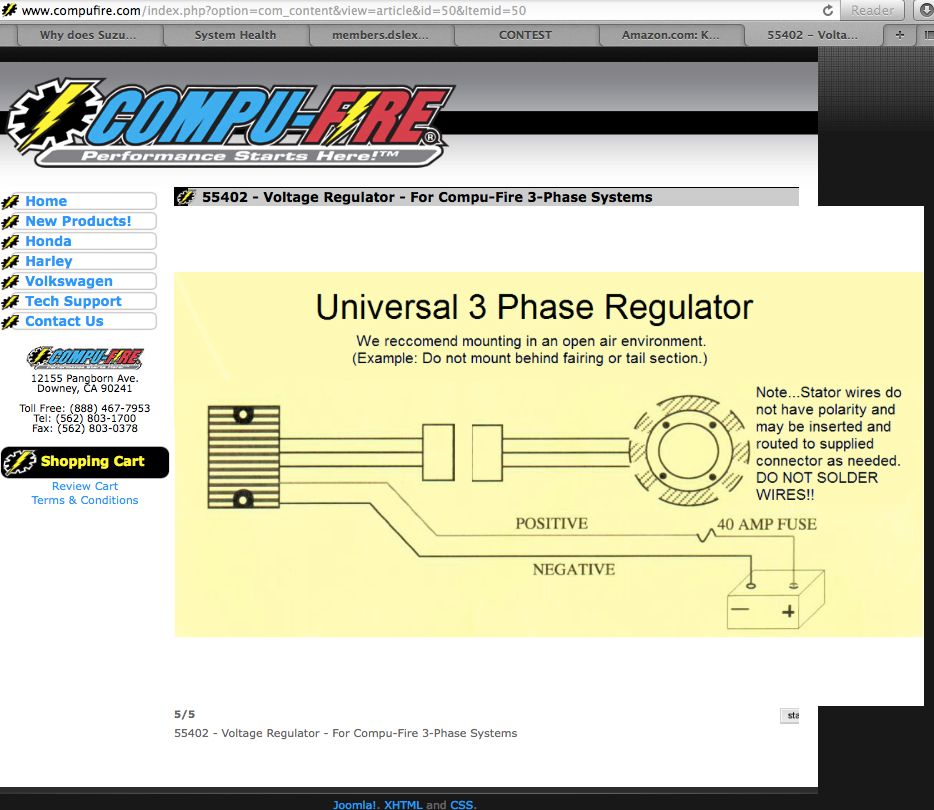
Compufire55402DirectToBattery.jpg


And I went to the battery directly since the R&R charges the battery, well that and runs the rest of the electrical system. I assumed that a better charged battery that also acts as a buffer/sort of capacitor to smooth the spiky voltage from the R&R was the place from which the electrical system draws its power, and less voltage drop/current loss from the R&R to the battery would provide the best case scenario...Stator>R&R>battery>fuse box>electrical loads, but I failed to consider that the R&R also provides power directly to the bike while running via the "T" and if we go to the battery directly then it all has to go through the main fuse then to the loads, stressing the fuse box and possibly leaving us stranded.

Best if the R&R connects back into the main harness to provide the power to the bike and charge the battery with what's left, and as long as the connections are all clean and the SPG method is used, there should be ample power left to charge, right?

My concern is what buffers/smooths the voltage from the R&R in this scenario and what about protection from a short to ground? I blew a whole bunch of LED's when my original R&R kicked the proverbial bucket...Does the battery somehow buffer it as well since it's connected through the T? I don't understand how. Perhaps the FET based power from the Compufire is clean/smooth enough that we don't worry about spikes, but what if it shorts to ground? What will protect the rest of the system, or keep the smoke from exiting the wires?

Should we be using that fancy fuse that came with the R&R in-line to the red wire harness or just wire it direct? It was a 40Amp fuse, I changed it out to a 20Amp, as 40 I'm told is way too much.
 

Attachments

  • Compufire55402DirectToBattery.jpg
    Compufire55402DirectToBattery.jpg
    16.4 KB · Views: 0
Me too. That's what I am going to do, I have been reading various PosPlayr posts and I noticed you hadn't heard back yet here either. I'd also like to know if it is recommended to fuse it, or keep it like the original R&R was, which wasn't fused. Either way, I will wire it as close to the harness "T" as possible, not down by the connector to the OEM R&R.


For me it was the nice inline fuse holder (albeit with no lid or cap!) and this:

Compufire55402DirectToBattery.jpg


And I went to the battery directly since the R&R charges the battery, well that and runs the rest of the electrical system. I assumed that a better charged battery that also acts as a buffer/sort of capacitor to smooth the spiky voltage from the R&R was the place from which the electrical system draws its power, and less voltage drop/current loss from the R&R to the battery would provide the best case scenario...Stator>R&R>battery>fuse box>electrical loads, but I failed to consider that the R&R also provides power directly to the bike while running via the "T" and if we go to the battery directly then it all has to go through the main fuse then to the loads, stressing the fuse box and possibly leaving us stranded.

Best if the R&R connects back into the main harness to provide the power to the bike and charge the battery with what's left, and as long as the connections are all clean and the SPG method is used, there should be ample power left to charge, right?

My concern is what buffers/smooths the voltage from the R&R in this scenario and what about protection from a short to ground? I blew a whole bunch of LED's when my original R&R kicked the proverbial bucket...Does the battery somehow buffer it as well since it's connected through the T? I don't understand how. Perhaps the FET based power from the Compufire is clean/smooth enough that we don't worry about spikes, but what if it shorts to ground? What will protect the rest of the system, or keep the smoke from exiting the wires?

Should we be using that fancy fuse that came with the R&R in-line to the red wire harness or just wire it direct? It was a 40Amp fuse, I changed it out to a 20Amp, as 40 I'm told is way too much.

I think you have your self a little confused. The R/R is always in parallel to the Battery in either case. It it is not then you will never charge the battery. The question is
A.) where do you put the fuse to protect the bike from the battery shorts and
B.) where do you tap off from the battery R/R to power the rest of the bike.

The OEM way and the one I recommend is the only one where the current flowing between the battery and R/R is only charging current. That minimizes voltage drops keeping your battery charging at the highest voltage possible.

The compufire drawing ignores how you power the bike. It looks good on the surface but it is "too simple"
 
Back
Top