Thanks for the replies. Allow me to respond in order received:
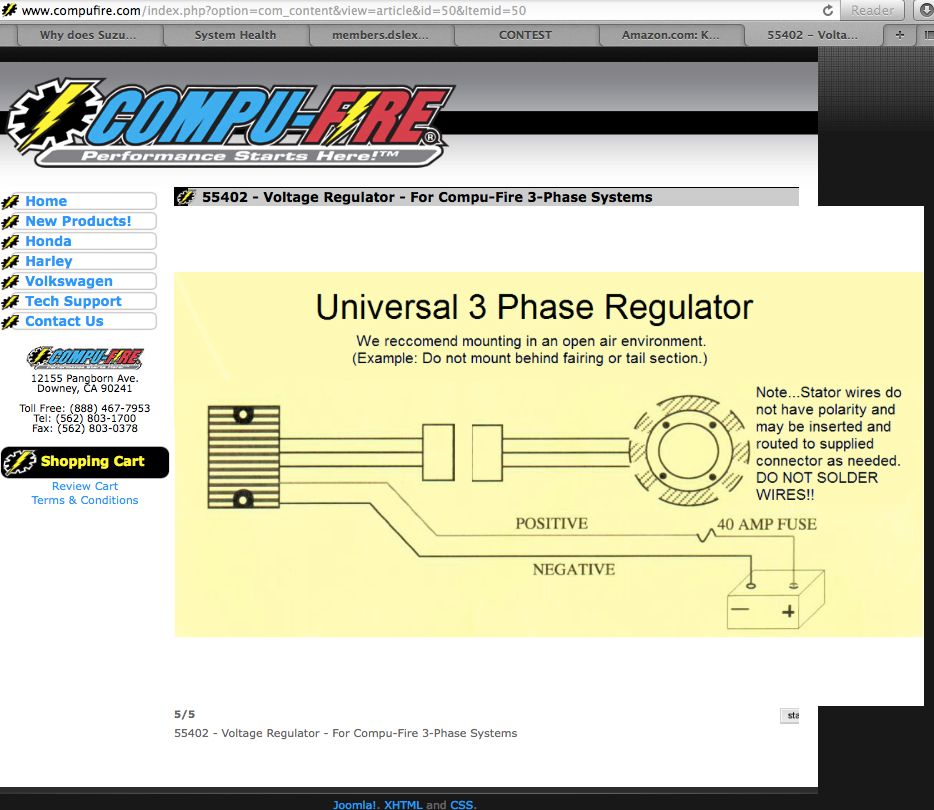
bakalorz - If I do this, I will place a 20A fuse between the R/R and the battery. I also have an LED voltmeter which glows in different colours, according to the voltage:
Voltage
Output
>15.20
Green/Red alternating (over-voltage)
>13.20
Green (charging)
>12.45
Amber (75% plus)
>12.25
Red slow flash (50% approx)
>12.00
Red 2 flashes, repeat
>11.80
Red 3 flashes, repeat
<11.80
Red 4 flashes, repeat
I believe that the combination of these two safeguards will be sufficient safeguards to warn me if an overcharging occurs.
However, I believe you might be a bit confused. I am looking at a wiring diagram right now. If I go straight to the battery and the main fuse blows, the Battery no longer has power to supply to Ignition Switch, which cannot supply power to the other 3 fuses, and the engine dies, the bike shuts down, including the lights.
OTOH, if I keep it in the loop and the main fuse blows, the R/R is still supplying voltage to the Ignition Switch, which in turn supplies the other 3 fuses, so the bike keeps running. However, the R/R now believes the battery is severely undercharged and goes through the roof. And there is no fuse to protect the system any more. Please correct me if I am reading the diagram wrong.
Matchless, you are correct. In OEM configuration the supply from the R/R to the ignition switch is not fused. Please see previous reply.
OldVet66, you are correct. If the main fuse dies you are done.
Let me theorize a bit further if I may: In my TransAm I place relays everywhere it is very important to keep maximum power available. Each relay is fused in case things get out of hand. Where I really, really care, I also place a bimetal breaker in series with the fuse. If it overheats, the metals expand away from each other and the circuit broken. If I do this, there will be a bimetal breaker in place also.
I am really attempting to understand and grasp this circuit, so please LMK if I am mistaken in some area.
Thank you.
You have gotten deep enough into this that you should be using a schematic and askng questions about a schematic. Doing a failure modes analysis is the correct way to approach it (ask you self what happens if this shorts or that).
Right now you seem to have conviced yourself to put a 20 amp fuse between battery and R/R but it is not clear whether that is in the original OEM "T" configuration (which only requires 15 amp fuse) or the modified version that requires 20 amp and (tries) to goes around the stock fuze box?